
Keep a sense of purpose
How can I find my purpose?
Identifying a meaningful and regular task or activity can help provide a sense of purpose to your life. It is important to choose an activity that is personal to you and reflects your interests and skills. Remember, it doesn’t matter how big or small the activity is, as long as it has meaning to you.
On this page we:
- suggest some questions you might want to ask yourself when identifying your chosen activity
- provide some examples of activities that we have identified from our research

I visit one chap in a care home who also has dementia. He is 12 years older than me and I visit him on a Friday. We talk through his window – usually around 45-50 minutes and we laugh and joke: he cheers me up and I cheer him up.
A person with dementia talking to our researchers

What questions do I need to ask myself before choosing my activity?
Before identifying your activity, you may want to ask yourself some questions to help you decide. In this diagram, we have suggested some key questions that could help you choose your meaningful activity. We have also provided different examples from our research. These examples are what people have told us they do and may provide some inspiration.
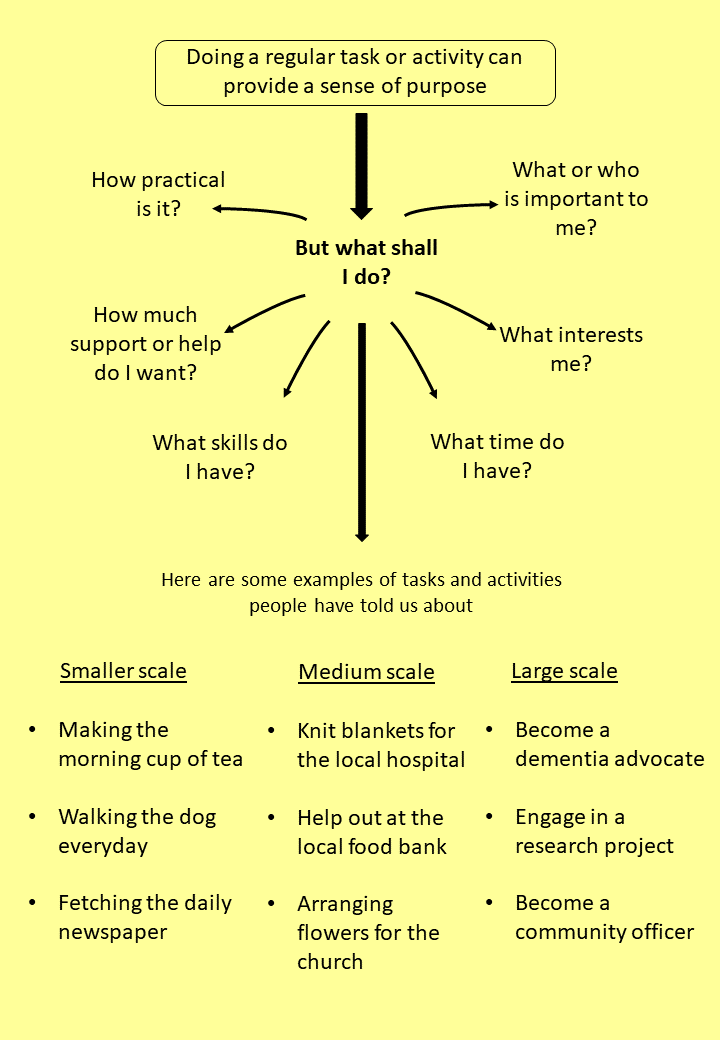
Finding my sense of purpose
You can download a blank version of the diagram to complete yourself.
Click here to download the diagram so you can fill it in.
Dr Rachel Collins provides some tips on what to think about when finding your sense of purpose. Rachel says "It is important to find something you enjoy and don’t be afraid of trying different things. When filling out the diagram you may want to think about the following:
- What or who is important to me? – the most important thing is to do something you enjoy and brings happiness and meaning to both yourself and maybe others. You are then more likely to continue, develop a habit and achieve that sense of purpose. Also, think about any charities, causes or organisations that are important to you and may be able to help.
- What interests me? – what hobbies, activities or jobs do you do or may have done in the past, that you found enjoyable and stimulating? This could be doing something you like doing quietly and peacefully on your own, like drawing and painting. It could be that you find activities involving lots of people, such as working with a local charity, the most stimulating and rewarding.
- What time do I have? – decide on how much time you want to and can dedicate to the activity and how often. You might want to undertake something that requires a few minutes every day, or a couple of hours every week. You might prefer to do something that requires more time commitment but is less frequent. Whatever you choose has to be realistic. It needs to fit in with your existing commitments and lifestyle without overburdening yourself.
- What skills do I have? – think about the skills you have. For example, are you good at talking to people, writing, languages, music, sports? Focus on what you can do and not what you can’t do. However, some activities may require you to learn new skills and so ask yourself “Do I want to learn something new or would I rather use the skills I already have?”
- How much support or help do I want? – do you want to be able to do the task independently or with input from others? If you do want extra help or support, what type and how much do you want? For example, would you want help with setting up a computer but then be left to get on with it? Or alternatively do you want to be part of a large supportive team and network, such as helping on a research project?
- How practical is it? – this also links with some of the points discussed above. You may have decided on a fantastic idea that you want to do but you have to be practical and realistic, and ask yourself some serious questions. Can you get to the location? Does it require going out somewhere and are there the facilities available to support your needs? Can you financially afford to undertake the activity on a regular basis? Would you be putting your own health and wellbeing at risk?
Finally, it doesn’t matter how big or small the activity is as long as it helps you. I hope these tips help with finding your sense of purpose."
More examples
Here are some more examples of people we spoke to talking about what gives them purpose.
I mean, we love walking anyway. And we've got all the fields at the bottom. We've got a dog and so we take her out for walks.
A carer talking about shared activities
I’ve been doing lots of baking, but it’s getting boring. I have a couple of horses and they give me that sense of normality and sense of purpose.
A person with dementia talking to our researchers about keeping busy during the COVID-19 pandemic
I’ve been involved with the local WI in making scrubs for the hospital, providing food for the food bank, and items for shoe box contributions for countries in Eastern Europe who are still in need. I’ve done lots of charity work in place of my usual meetings.
A carer talking to our researchers about keeping busy during the COVID-19 pandemic
How could we improve this page? Visit the Contact us page to let us know.
How can I find my purpose?
You can print a paper version of this resource by clicking the button below.
